
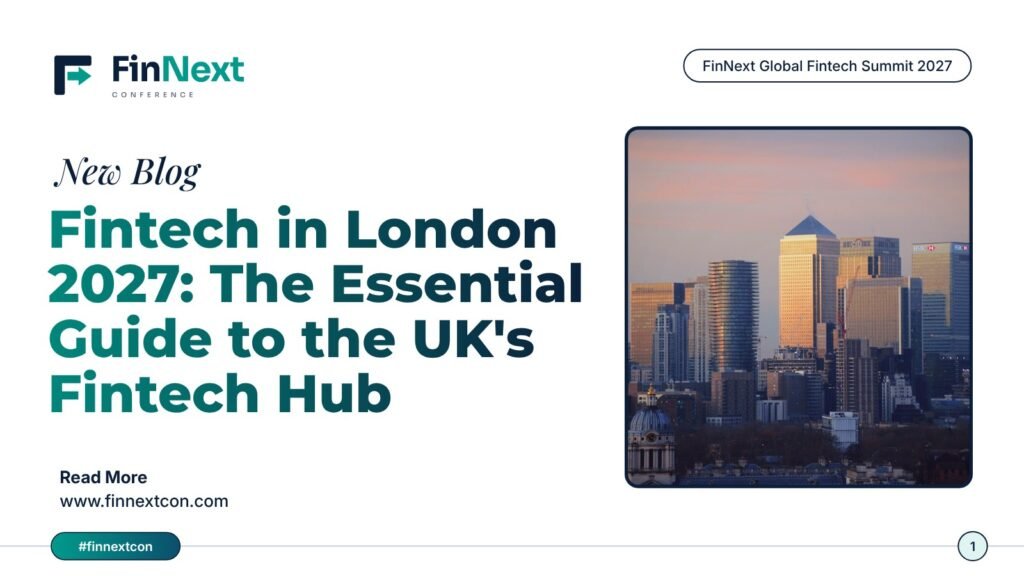
Fintech in London is going through a period of resetting rather than retreat. Funding has cooled from its peak, but the city still ranks second only to New York as a financial centre, and the UK is rewriting its rules for payments, crypto and stablecoins. This guide explains how the London fintech market works in 2027: who regulates what, how firms test new ideas with the regulator, how payments and open banking are changing, and what it all means if you are building, investing or banking in the UK.
We run FinNext, a one-day fintech summit with editions in Dubai, London and Singapore, and London is one of the markets our community asks about most.
Facts checked on 18 November 2026. Rules and figures change quickly, so confirm the details with the regulator or the source before you act on them.
In this article
Why fintech in London matters in 2027
London remains one of the world’s leading financial centres. In the 40th Global Financial Centres Index, published in September 2026, it was ranked second overall behind New York and sixth for fintech, down from fifth, with Hong Kong, New York, Shenzhen, Singapore and Shanghai ahead of it, Mondo Visione reported.
The sector is large. When the Chancellor set out plans to help financial services firms scale in October 2025, HM Treasury said the UK had more than 3,000 fintech firms employing over 75,000 people, and that Revolut planned to invest £3 billion over five years and open a new headquarters in Canary Wharf (GOV.UK).
Funding is the weaker part of the picture. UK fintech investment, including M&A, private equity and venture capital, fell to £1.8 billion in the first half of 2026 from £5.0 billion a year earlier, across 205 deals, according to KPMG. Even so, the UK ranked second only to the US for deal activity, and AI-related fintech took a quarter of the total, with £445 million across 79 deals.
Counting venture capital alone, Innovate Finance put UK fintech funding at US$1.8 billion across 181 deals in the same period, again second only to the US. The two studies measure different things, so their figures should not be compared directly.

Who regulates fintech in London and the UK
UK fintech companies deal with a small number of national regulators. Which ones you deal with depends on whether you take deposits, move money, give investment services or handle cryptoassets.
| Regulator | What it covers | Why it matters to fintechs |
|---|---|---|
| Financial Conduct Authority (FCA) | The conduct of about 35,500 firms, and prudential supervision of many that the PRA does not cover | Authorises most fintechs, runs the sandbox and will authorise crypto firms |
| Prudential Regulation Authority (PRA) | Part of the Bank of England; supervises the safety of banks, building societies and insurers | Decides whether a digital bank can get and keep a banking licence |
| Bank of England | The UK’s central bank; under the new regime it will oversee systemic sterling stablecoins | Sets the rules for stablecoins used widely for payments |
| Payment Systems Regulator (PSR) | Competition and innovation in payment systems | Its role is being moved into the FCA |
| HM Treasury | Financial services legislation and policy | Writes the laws, such as the new cryptoasset regulations |
Sources: the FCA and the Bank of England on their roles. The FCA and PRA were both created in 2013, when the Financial Services Authority was disbanded. Since 2023 the FCA has also had a secondary objective to support the UK’s international competitiveness and growth.
The landscape is getting simpler. On 21 April 2026 HM Treasury confirmed it would fold the PSR into the FCA, and said it will bring forward primary legislation to do so when parliamentary time allows (Mondo Visione).
How the FCA supports fintech innovation
The FCA offers several services for innovative firms, and its toolkit has grown in recent years. Three services are most relevant to London fintech founders in 2027.
The Regulatory Sandbox
The FCA’s Regulatory Sandbox lets firms test new products live with real consumers under close supervision. It accepts applications at any point in the year from authorised and unauthorised firms of all sizes, and tests are usually small, short and limited in customer numbers.
Support can include a restricted authorisation, individual guidance, rule waivers and “no enforcement action” letters. The sandbox is not an exemption: firms carrying out regulated activities still need to be authorised or registered.
The Supercharged Sandbox for AI
The Supercharged Sandbox is a cohort programme for testing AI in financial services. It gives firms GPU computing power, AI tools, synthetic datasets and mentoring at no cost, and taking part does not require FCA authorisation. The second cohort runs from 13 July to 31 December 2026, with 21 organisations chosen from 199 applications.
The Scale-up Unit
In October 2025 the government announced a Scale-up Unit, jointly led by the FCA and the PRA, to give fast-growing firms dedicated support on regulation. It opened first to deposit-takers and insurers, and the government said it would extend to fintechs from early 2026.
Payments and open banking: the UK’s rails
Much of what London fintechs build runs on shared national infrastructure, and the UK’s main rails are well established.
- Faster Payments. Created in 2008, the system runs day and night, every day of the year, and supports payments of up to £1 million. It processed 5.55 billion transactions worth £4.84 trillion in 2025, according to Pay.UK.
- Open banking. UK open banking has passed one billion payments and 100 billion API calls. In June 2026 alone there were 40.16 million open banking payments, including 7.73 million variable recurring payments used for sweeping money between a customer’s own accounts, Open Banking Limited said.
- Adoption. In July 2025 there were about 15.16 million open banking user connections, equivalent to nearly one in three UK adults, though Open Banking Limited notes that it counts connections rather than unique people.
- A national strategy. HM Treasury published its National Payments Vision on 14 November 2024, responding to the 2023 Future of Payments Review. A Payments Vision Delivery Committee is working out who does what in the future retail payments system, with its latest update published on 2 July 2026.
For a fintech, these rails lower the cost of moving money and make account-to-account payments a real alternative to cards in some use cases. If you are new to the topic, our guide to open banking explained compares the UK model with the UAE and Singapore.
Digital banks and the London neobank model
The path from start-up to fully licensed bank is a defining feature of UK fintech. New UK banks can begin in a “mobilisation” phase, holding a licence with restrictions while they build out their systems and capital.
Revolut shows how long that path can be. It received a UK banking licence with restrictions, including a cap on deposits, in July 2024, and on 11 March 2026 it announced that the PRA had approved its exit from mobilisation, allowing it to launch as a full bank to its 13 million UK customers, Tech.eu reported.
For founders, the lesson is that a banking licence is a multi-year project that depends on capital, governance and systems as much as on the product. Many fintechs choose instead to hold an e-money or payments licence, or to partner with an existing bank.

Crypto, stablecoins and the digital pound
The UK is bringing crypto firms under full financial regulation. According to law firm Clifford Chance, HM Treasury made the Financial Services and Markets Act 2000 (Cryptoassets) Regulations 2026 in February 2026, and the new regime broadly goes live on 25 October 2027.
- Authorisation. The FCA’s application window for crypto firms runs from 30 September 2026 to 28 February 2027.
- Stablecoin issuers. The FCA published its final rules for stablecoin issuance in June 2026, in policy statement PS26/10.
- Systemic stablecoins. The Bank of England set out its regime for systemic sterling stablecoins on 22 June 2026: 1:1 backing, with 30% held as unremunerated deposits at the central bank and the rest in short-term UK government debt, redemption within 24 hours, no interest for holders and an issuance limit of £40 billion per stablecoin, subject to review.
The digital pound is still undecided. The Bank of England said it would decide in 2026 whether to proceed, and Economic Secretary to the Treasury Lucy Rigby told Parliament the government intends “to announce a decision on the digital pound by the end of 2026”, PublicTechnology reported in October 2026.
Setting up a fintech in London: a practical roadmap
Every company’s route is different, but most founders work through the same questions in roughly this order. Use it as a checklist for conversations with your lawyers and the FCA, not as a substitute for them.
- Define the regulated activity. Payments, e-money, lending, investments, deposits and cryptoassets each have different permissions. Write down exactly what your product does with customer money and data.
- Match it to a regulator. Most fintechs are authorised by the FCA alone; deposit-takers also need the PRA, and crypto firms will need FCA authorisation under the new regime.
- Use the FCA’s innovation services. Pre-application support, the Regulatory Sandbox and, for AI products, the Supercharged Sandbox can save months.
- Decide whether to build or partner. A bank or payments partner can get you to market faster than your own licence, at the cost of margin and control.
- Plan banking, safeguarding and compliance early. You will need a bank account, anti-money-laundering controls and data protection policies before serving customers.
- Budget for time and capital. With funding tighter than in recent years, build a buffer into your licensing and fundraising plans.
What it means for founders, investors and banks
- Founders: London still offers deep talent, a large customer base and a regulator with well-developed innovation services. Fundraising is harder than it was, so lead with revenue, unit economics and a clear licence plan.
- Investors: lower valuations and fewer deals can mean better entry points, and AI-related fintech is taking a growing share of capital. Check every target’s authorisation status and its plans for the new crypto and payments rules.
- Banks: open banking volumes, variable recurring payments and the coming stablecoin regime will change how customers pay and save. Partnerships with fintechs remain a practical way to keep up.
- Everyone: 2027 brings the crypto regime’s go-live, the PSR’s move into the FCA and a decision on the digital pound. Keep an eye on each regulator’s publications.
This article is general information, not legal or financial advice. Rules change, so check the FCA’s and the Bank of England’s current requirements, and take professional advice before you launch or invest.
Fintech in London: frequently asked questions
Who regulates fintech companies in London?
Most fintechs are authorised and supervised by the Financial Conduct Authority. Banks and insurers are also supervised by the Prudential Regulation Authority, part of the Bank of England, and the Bank of England will oversee systemic sterling stablecoins.
Is London still a leading fintech hub?
Yes. London was ranked second overall and sixth for fintech in the 40th Global Financial Centres Index in September 2026, and the UK was second only to the US for fintech deal activity in the first half of 2026, even though funding fell.
What is the FCA Regulatory Sandbox?
It is an FCA service that lets firms test new financial products live with real consumers under close supervision. It accepts applications all year from authorised and unauthorised firms, but it is not an exemption from authorisation.
When does the UK’s new crypto regime start?
The new regime under the Cryptoassets Regulations 2026 broadly goes live on 25 October 2027. The FCA’s application window for firms runs from 30 September 2026 to 28 February 2027.
When is FinNext London 2027?
FinNext London takes place on 13 October 2027. Like every FinNext edition, it includes keynotes, panels, investor meetings and founder introductions, a startup showcase and the FinNext Awards ceremony.
Join us at FinNext 2027

Meet the London fintech community in person at FinNext London on 13 October 2027. Get your pass, or see our list of the top fintech events in London and the UK to plan the rest of your year.